

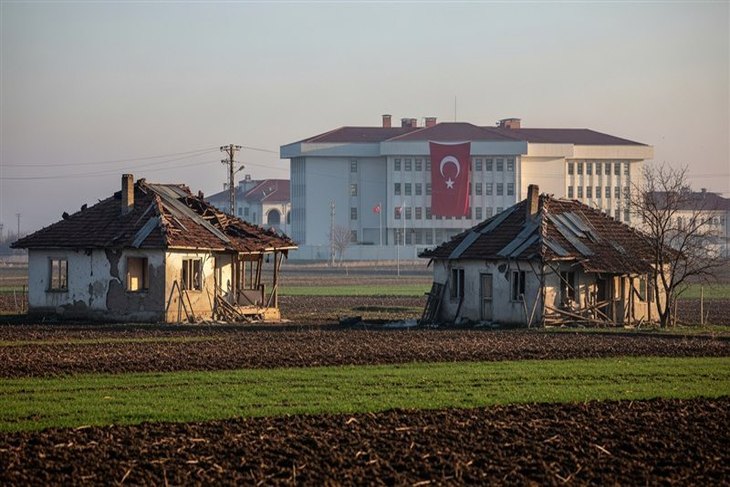
Foreign buyers in Türkiye usually buy finished buildings. Those who buy land — a plot in a coastal district, an agricultural parcel, a development site — encounter a rule that has no equivalent in the apartment market: an obligation to develop what they bought, on a deadline, with a ministry watching. This article explains Article 35 of the Land Registry Law, the limits it sets on foreign ownership, and the project obligation that catches investors expecting to hold a plot passively.
The framework: Article 35 of Law No. 2644
Foreign nationals may acquire immovable property in Türkiye subject to reciprocity and to statutory limits. The provision governing this is Article 35 of the Land Registry Law No. 2644, substantially rewritten by Law No. 6302 in 2012, which abolished the previous reciprocity requirement for nationals of designated countries and replaced it with a system based on ministerial determination.
Two quantitative limits sit at the centre of the article, and both are checked by the land registry before any transfer completes.
The two ceilings
Thirty hectares per person. A foreign national may hold, across the whole country, immovable property and independent limited real rights totalling no more than thirty hectares. This is a personal, nationwide cap — not per transaction and not per province.
Ten per cent of the district. The total area held by foreign nationals in any given district may not exceed ten per cent of the privately owned surface area of that district. This is not a limit on you individually; it is a limit on foreign ownership in aggregate, and it operates on a first-come basis.
In most of Türkiye the district ceiling is a theoretical constraint. In a small number of coastal districts with concentrated foreign ownership it is real, and transactions there are refused when the district is at capacity. Where you are buying in a location popular with foreign buyers, this is a check to make before committing rather than a formality at the counter.
Where foreigners cannot buy at all
Independently of the ceilings, acquisition is prohibited in military forbidden zones and security zones, and restricted in special security zones where permission from the relevant authority is required. These boundaries are not visible from the street or from a property listing, and they do not follow administrative borders in any intuitive way.
The land registry checks the position as part of the transfer. A buyer who has paid a deposit on a plot inside a restricted zone will discover the problem at that point, which is why the check belongs at the outset.
The project obligation
Here is the rule that distinguishes land from a finished building. Where a foreign national acquires immovable property without a structure on it — a bare plot, agricultural land, a development site — they must submit a project for the development of that property to the relevant ministry within two years of acquisition.
The rationale is straightforward. The statutory scheme contemplates foreign acquisition for use — a home, a workplace, a development — not for the accumulation of undeveloped land. The two-year deadline is the mechanism that gives effect to that policy.
Once approved, the project is recorded and its implementation is monitored by the ministry. The obligation therefore has two stages: submit within two years, then build what was approved within the timetable.
What happens if the deadline passes
This is where advice must be careful, because the consequence is serious and the details are administrative rather than mechanical. Failure to comply with the project obligation exposes the property to liquidation under the procedure set out in Article 35 — the property is disposed of and the proceeds paid to the owner.
Two points follow. First, this is not a fine to be absorbed; it goes to ownership. Second, the timetable starts on the date of acquisition, not on the date the buyer decides to build. An investor who buys a plot intending to develop it "in a few years" has already used part of the period.
If you own undeveloped land in Türkiye and have never submitted a project, the date of your title deed is the first thing to establish.
Land and the citizenship route
Land can be used for a citizenship application. The USD 400,000 threshold, the SPK-licensed valuation and the three-year annotation apply exactly as they do to an apartment.
What the citizenship route does not do is displace the project obligation. An investor who buys a USD 400,000 plot, obtains citizenship, and holds the land untouched is still subject to the two-year development requirement. The two regimes run in parallel, and the citizenship grant does not satisfy the land obligation.
This combination catches investors who chose land precisely because it required no management. It requires more management than an apartment, not less.
Agricultural land: a separate layer
Agricultural land brings its own rules under the Soil Conservation and Land Use Law No. 5403, principally minimum parcel sizes and restrictions on division that apply to Turkish and foreign owners alike. Land designated as agricultural cannot simply be built on; changing its designation is a planning process with an uncertain outcome.
Buyers attracted by the low price per square metre of agricultural land should treat that price as information rather than opportunity. It reflects what can lawfully be done with the parcel.
Companies rather than individuals
A Turkish company with foreign shareholders is a Turkish legal person, and its acquisitions are governed by a different provision — Article 36 of Law No. 2644 — rather than by the thirty-hectare individual cap. Acquisitions must fall within the company's field of activity as stated in its articles, and are subject to a governorate assessment process.
This is a legitimate structure for genuine development activity, and a poor one for holding a plot passively: it adds accounting, tax filing and corporate compliance to a passive asset. It is worth considering where a real project exists and worth avoiding where one does not.
Due diligence before you commit
- Title register. Ownership, share structure, mortgages, attachments, annotations.
- Zoning status. Whether the parcel is within a development plan, what is permitted, what floor area ratio applies.
- Designation. Agricultural, forest, pasture or urban — each carries different restrictions, and forest and pasture designations can defeat a purchase entirely.
- Military and security zones. Checked before, not at, the transfer.
- District ceiling. Whether foreign ownership in the district has reached ten per cent.
- Access and infrastructure. A landlocked parcel without a legal right of way is difficult to develop and harder to sell.
- Your own thirty-hectare position if you already own land in Türkiye.
Every item on this list is checkable in advance. None is checkable after a deposit has been paid to a seller who has stopped answering the telephone.
A short scenario
A European investor buys two hectares near a growing coastal town, attracted by the price and intending to build a house "when the children have finished school" — perhaps five years out. Title transfers without difficulty; nobody at the registry mentions the project obligation, because the registry's function is to record transfers, not to advise buyers.
Two years and one month later the obligation has been missed. The property is now exposed to the liquidation procedure, and remedying the position requires urgent engagement with the ministry rather than a leisurely design process.
Had the same investor submitted a modest project within the period — a single dwelling, properly documented — the obligation would have been satisfied and the timetable manageable. The cost of compliance was a fraction of the cost of the omission.
Frequently asked questions
Does the two-year obligation apply to apartments? No. It applies to property acquired without a structure on it.
What counts as a project? A development proposal appropriate to the parcel and its zoning, submitted to the relevant ministry. Scale is not the test; compliance and genuineness are.
Can I sell the land instead of developing it? Sale is possible, subject to the annotation if the property was used for citizenship. Selling does not retrospectively cure a missed obligation for the period you owned it.
Is the thirty hectares per property or per person? Per person, across the whole country, aggregating all holdings.
Can my spouse and I hold thirty hectares each? The cap is individual, so in principle yes — but structuring purchases to circumvent a statutory limit invites scrutiny.
How do I find out if a district is at its ten per cent ceiling? Through enquiry at the land registry directorate before the transaction.
Can foreigners buy forest land? Forest land is generally outside private ownership altogether. A parcel described as "forest view" is not the same as a parcel designated as forest — verify the designation.
Before you buy a plot
Land in Türkiye is not a passive asset for a foreign owner. It carries a development obligation with a hard deadline, sits inside two statutory ceilings, and may fall within zones where acquisition is restricted or prohibited. All of that is discoverable before a deposit is paid.
Dural Hukuk carries out zoning, designation and restricted-zone checks before any land purchase, advises on the Article 35 project obligation and its timetable, and represents foreign owners in dealings with the relevant ministries. Call +90 535 260 74 54 or use the contact form on this site.
This article is general information on Turkish law as at August 2026 and is not legal advice. Land transactions turn on the specific parcel; obtain advice before committing funds.